
Establishment of the TIA
The TIA has a long history of Torquay community involvement.
After the 1886 town sales, houses/shacks began to spring up, and bathing boxes along the front beach increased. -Progress and development needed to be controlled, so Harry Rudd, a Geelong tailor who spent many weekends at Torquay fishing, proposed forming a progress association. The town at the time was called Spring Creek. Hence, the initial name was the Spring Creek Improvement Association. The name was changed when the town name was to Torquay in 1892.
The initial meeting in 1889 was held at the office of John Longville Price, who was elected President of the new group with Harry Rudd, Secretary. Messrs Fischer, Calder, Wilton, Beales, H Taylor and JW Taylor were other committee members. Armed with a vision to improve access to Torquay and the amenities in the town to attract tourists, the Association set about improving access to roads and sanitation. They protected public land, fought for Taylor Park, built the public hall, advocated for a postal service to Torquay, electricity, telephone and police services, and access to a sewerage system.
About the TIA HALL
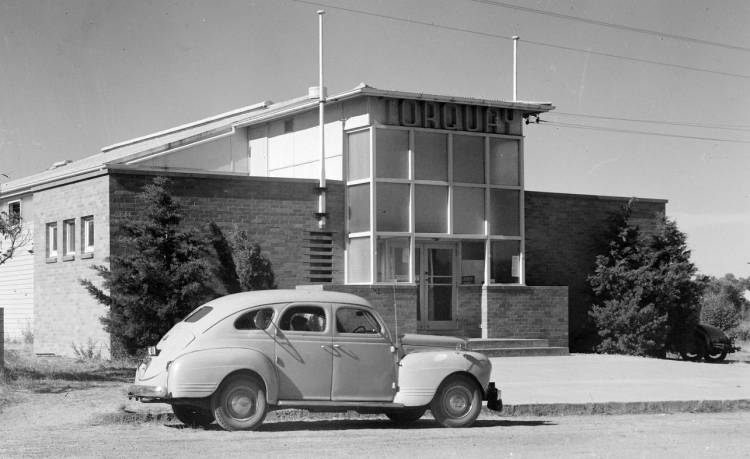
The current hall emerged out of the ashes from the 1940 bushfire that almost wiped out the town.
At a special meeting of the Torquay association in November 1892, discussion was undertaken about purchasing a block of land for building a public hall. William Bell was the chairperson who encouraged the committee to accept the hall’s design. The committee accepted the plan for a -hall measuring 40 feet by 25 feet, with two rooms at the rear.
Immediately the Public Hall Company Limited was established to purchase land to erect a public hall and all necessary outbuildings, fences and gates for religious and educational purposes. The company’s capital was £375 divided into 75 shares of £5 each. It was officially registered in the Victorian Government Gazetteer on 24 March 1893
Tenders were called and within a month, the Public Hall Company Limited had accepted the tender contract for the hall which was to be ready for opening on 26 January 1893. It was planned to have a church service four days earlier, conducted by the Rev. A. R. Edgar, followed by a grand concert on the 26th when the formal opening ceremony would take place with William Bell, ex-Mayor of Geelong as chairman.
At the opening William Bell mentioned that the recreation hall was designed by Mr Durran, architect of Geelong and built by Messrs J. C. Taylor and Sons, also of Geelong. The total cost of the site and building was £300. Public money had been raised with the debt at the time of opening was £150 with the hope of clearing the debt quickly. He told the audience that the building would be a source of pleasure and profit to residents and visitors at Torquay.
Rev. C. Robertson held Presbyterian church services fortnightly in the new hall.
The six-month financial report in 1893 cited that income was moderate, with further furnishing to be purchased. It was regretted that half the shares still had not been taken up, but the company was optimistic that the finances would improve with more houses being built.
However, the depression made repayments impossible so by 1898 the bank foreclosed putting the Torquay Public Hall Co. Ltd into liquidation. Edward G Gurr was appointed Liquidator. Tenders called for the purchase of the building and furniture in July that year.
John William Taylor, a member of the TIA committee at the time, purchased the hall for the community and the TIA took the task of clearing the debt. They ran concerts, euchre nights and later movies proved to be a popular activity in the hall.
The Certificate of Title shows that the debt was paid off within ten years when the TIA Trustees – JN McCann, EJ Taylor were identified on the title as proprietors.
In 1922 the hall was extended another 24 ft so that it was more suitable for a broader range of entertainment. A new elevated biograph box to show movies was installed.
The current building replaced the original hall after it was destroyed in the bushfire that ravaged Torquay in 1940. A.C. Leith and Bartlett designed the new facility in an interwar Modern Functionalist style. And just as William Bell mentioned in his address at the opening of the first hall, it has been socially significant for its important associations with community life and historically significant for its interwar architectural design.
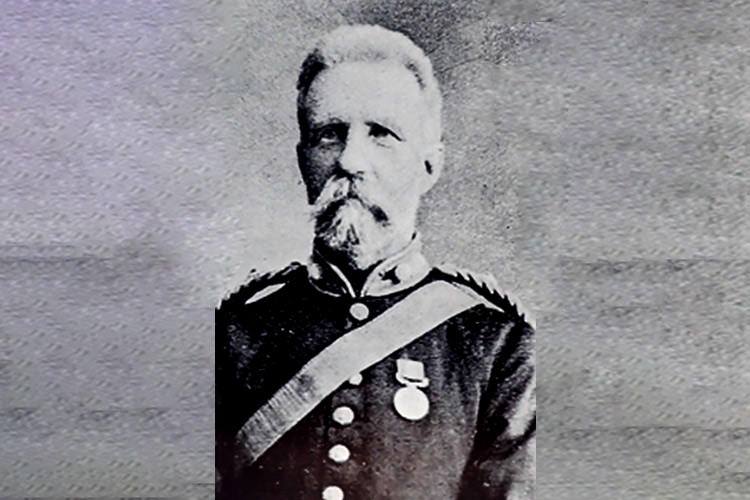
TORQUAY IMPROVEMENT ASSOCIATION PRESIDENTS
Read Here
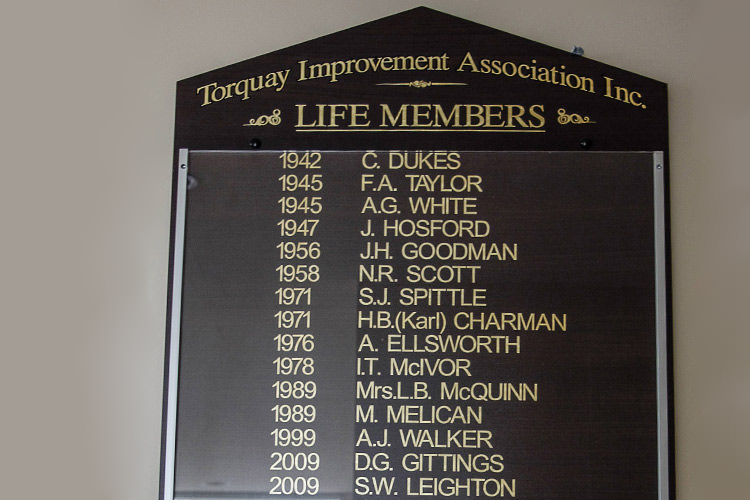
TORQUAY IMPROVEMENT ASSOCIATION LIFE MEMBERS
Read Here
 Torquay Improvement Association